

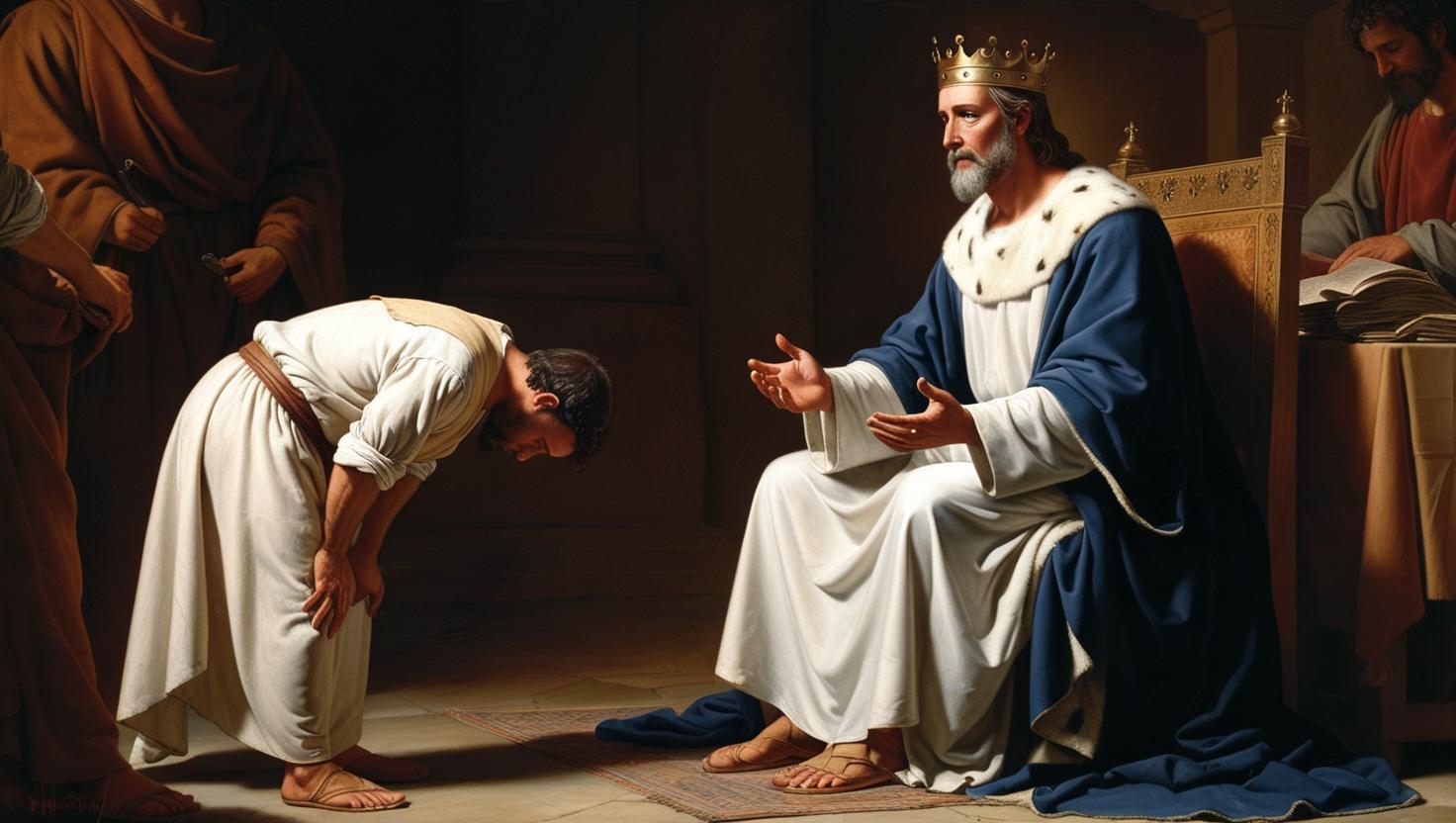
Therefore is the kingdom of the heavens likened to a man, a king, who willed to take account with his servants. And when he had begun to take it, one was brought to him who owed him ten thousand talents. But he not having anything to pay, his lord ordered him to be sold, and his wife, and children, and all that he had, and it be paid. Then the servant, falling down, worshiped him saying, Lord, bear with me, and I will pay thee all. And the lord of that servant, being moved with compassion, released him, and forgave him the debt. But that servant, going out, found one of his fellow servants, who owed him a hundred denarii, and taking hold of him choked him, saying, Pay me what thou owest. Then his fellow servant, falling at his feet, implored him, saying, Bear with me, and I will pay thee all. And he was not willing; but going away, cast him into prison, until he should pay what was owed. But his fellow servants, seeing what was done, sorrowed greatly; and coming, they gave their lord to understand all things that were done. Then his lord, calling him, says to him, Thou wicked servant, I forgave thee all that debt, since thou didst implore me. Shouldest thou not also have had mercy on thy fellow servant, even as I had mercy on thee And his lord, being angry, delivered him up to the tormentors until he should pay all that was owed to him. So also shall My heavenly Father do unto you, unless every one of you forgive his brother from your hearts their trespasses.
(Matthew 18:23-35)
We come now to the second part of our look at this parable which describes the kingdom of heaven being like a king wanting to settle accounts. Now whenever we read of a king in the Word we are dealing with a representation for truths, or ruling principles, and as this king and his actions are likened to the kingdom of heaven, we can see that the principles being illustrated here must be those that govern how we experience the kingdom of heaven operating in our lives. The nature of truth is such that it probes our being, looking to uncover our motives and attitudes and to bring them to our attention. So this king that calls his servants to account is the Word or Divine Truth and we see this in the actual word translated as account for interestingly, this word is a translation of the Greek word logos which is the term in John’s Gospel attributed to the Lord in the statement;
In the beginning was the Word and the Word was God.
What we have here is, In the beginning was the Logos and the Logos was God. The Logos is the Divine Truth that became flesh and dwelt among us; so John draws our attention to Jesus as the Logos or the full account of Divinity in Human form.
So logos means Word, but it also means account and in this, we can see the intimate relationship which we looked at last time of truth and responsibility. It is no coincidence that the Word presents us with these two ideas linked to this one word, for from a spiritual perspective they are inseparable. But this is only part of the story. We can ask, What is the king doing with this account? The Scripture says he willed to take account with his servants. Now a servant carries out the will of the king through the administration of various offices and uses on which the health of the kingdom depends. So servants can represent those things within our mind which sit beneath the level of Divine Truth but are designed to carry out its plans and purposes. For Divine Truth finds it place within us as a king when we freely place ourselves under its authority. What this parable teaches us is that once we do this, then we undergo a process whereby those ideas and affections within us that claim to serve the Word, are called into account.
In the inner world of the kingdom of heaven, which is the world of our will and understanding, it is our thoughts and affections that are supposed to serve the Lord’s kingdom within us. And in the processes of our spiritual growth and development, of our regeneration, it is these kinds of things that are constantly being called into account. Isn’t this the case? Isn’t this our experience? When we begin to respond to the truths that we learn from the Word, don’t we experience this spiritual principle operating by having the things of our inner world being called to account? Ways of thinking and feeling and behaving that we wouldn’t have given a second thought to before … we now find ourselves reflecting upon. The Word gives us the ability to examine the quality of our thoughts and affections, an ability to look at our attitudes and motives. And what the light of its truths show us, make us response-able and with that, we are also made account-able.
The actual phrase, willed to take account, taken as a whole is interesting in that when we examine the phrase in its original Greek we find hidden within it the purpose for which this taking or settling of accounts is performed. To see this we need to consider the word translated take as in, to take account. In the Greek the word is soon-aheero which literally means to-together-lift from soon meaning together and aheero meaning to lift. The idea is one of assessing things by bringing them into connection with higher principles through lifting them from a lower to a higher level of mind or thinking. This is done as if of ourselves but really it is an ability from the Lord through the truths He furnishes us with. It is done by our being willing to reflect on our thoughts, motives, and behaviours from the light of what the Word teaches. When we do this, we lift what is lower into the light of what is higher. This is what is meant by a king taking account of his servants when the kingdom of heaven is operating in our lives.
What is being illustrated for us in this parable is the power of the Word to bring what is serviceable to the spiritual life into connection with the king. The first thing that we see in this accounting for what is in our minds, is the state of things on the lower plane of the thoughts and affections which we dwell in. Before coming into a knowledge of spiritual truths, we live as if our life is our own, to do with as we desire. The natural man, or mind, is imprisoned in this fallacy of the senses. It believes that it is the source of its life, that it somehow has life in itself because this is how it feels. This natural man, this natural mind, cannot of itself see its way out of its own deception. Because this is the case, the Lord has revealed truths through Divine revelation concerning the state of the human condition – so that we can come to see things as they really are. That only the Divine has life in Itself and that all others are merely recipients of this life. That the sense of having life within ourselves is an appearance necessary for our exercise of freedom in spiritual things. That without this feeling of life as our own, we would have no sense of being autonomous, independent beings and so have no possibility of having an experience of reciprocity with Divine Love and its wisdom. For the nature of what is Infinite Love gives all that it has to what is other, and the nature of what is finite mirrors this in its relationship to It.
However, the appearance that we are the source of our life is a powerful deception for the natural man, for this level of mind. There isn’t a day that goes by where we don’t act from this belief. It is so powerful a deception that we must constantly remind ourselves that our life is not our own and that as receivers of life from the Lord we have a responsibility to work to have our thoughts and affections brought into what can serve of the kingdom of heaven. This being the order of creation for all human beings. The realisation that our life flows into us and only appears as ours, can be a real shock once its implications are seen for it requires a total shift in our thinking and a reorganisation of our beliefs. The power of this shock is illustrated in the parable by the servant coming into a realisation that nothing he has is his own, but that it all was given to him by the king and that now king wants it back. The debt is ten thousand talents and just to give you some idea of the numbers involved here, one talent was the equivalent of seventeen years wages.
The use of this imagery is to drive the point home that all that we have is the Lord’s, and because it is His, we actually have nothing in ourselves to give to settle the account. In spiritual terms, we can’t acquire anything for ourselves because what is available to us to make such a payment must come from the Lord in the first place. It’s like having no income but managing to get a one hundred percent finance to purchase a house and then because we don’t have an income, then having to borrow everything we need each month to make the repayments. For a while we live in the house and even come to believe that it’s ours, but at some point we are called on to settle the account and it is then that the reality of our predicament is realised. While we lived in the house we were comfortable in the illusion that we possessed a home we could call our own. And by all appearances this is exactly how it looked. Now, however, things are beginning to present very differently.
While we live with a belief that our life is our own and that we are accountable to no one but ourselves, we live for ourselves. Everything in our minds, our thoughts, affections, attitudes and desires are organised around the love of self which perpetuates the illusion that all is well. We are blinded by our egos and see ourselves as much more important than we really are in the scheme of things. It is like those we find described in the doctrines for Spiritual Christianity as living in hell, who see themselves as living in wealth and splendour, only to find that when heaven’s light shines on their situation, that they live in caves amidst excrement and are clothed in rags.
Heaven’s light shines in on our state of life when we allow truths from the Word to shine on the attitudes, beliefs, and motives which are active in our minds. This is what is meant by a king taking account of his servants. The things the natural mind regards as precious, the spiritual mind sees must be sold, which means that the attachment we have to our sense of life being our own must be given up. All the beliefs and attitudes in which we have immersed ourselves must be relinquished and submitted to the authority of the Lord so that the things of our understanding and affections might be reordered to serve the purposes of the kingdom of heaven.
But knowing this and doing it are two very different things, and in the moment of realisation we feel that it is too much – the king, or this ruling principle of the kingdom of heaven, requires all that we have or feel ownership over to be sold or given up in order to pay the debt. But the teaching of the Word is clear – if we are to find our life, we must lose it. To the rich young ruler of the Gospels, Jesus said that if he was to inherit eternal life he had to sell all that he had and give the proceeds to the poor and then follow Him. This idea of selling to gain the things of heaven which we also saw in the parables of the treasure hidden in a field and the pearl of great price, has to do with giving up our sense ownership over our lives through acknowledging that all that we have is from the Lord. To commit ourselves in this way is not an easy thing for us to do and the sense of loss involved feels to be too much. We want to hold on to some things but we also want to do the ‘right thing’ and acknowledge the Lord. And so we see initially that the servant in this parable falls down and worships the king acknowledging his debt saying he will repay.
And when he had begun to take it, one was brought to him who owed him ten thousand talents. But he not having anything to pay, his lord ordered him to be sold, and his wife, and children, and all that he had, and it be paid. Then the servant, falling down, worshiped him saying, Lord, bear with me, and I will pay thee all.
This submission shows us an important aspect to how the kingdom of heaven works. Until we are able to acknowledge our state of dependency on the Lord, we can’t experience the healing that comes from being released from the burdens that weigh us down when we try to live our lives independently from Him.
And the lord of that servant, being moved with compassion, released him, and forgave him the debt.
Now the Lord does not withhold anything from anyone, including His forgiveness. Wherever the Lord is, and He is everywhere, forgiveness is there because in a very real sense the Lord is forgiveness itself. But if we shut the Lord out of our lives we will feel burdened by the disorder that arises when we live from the belief that we are the source of all that we think and feel, that we are the source of our life. So the appearance of being forgiven arises from a change within us for when we being to work from our understanding of what the Word teaches, then there is a sense of being released from the burden that self-love places upon us.
But when we open ourselves up to working with the Word and receiving truth, we will also see what we are attached to in what resists this. And we can become obsessed with seeking the Lord’s forgiveness due to a misplaced sense of guilt and shame. When this happens we can experience negative and difficult states which make it seem as if the Lord is distant from us. We find this dynamic illustrated in the second part of this parable which shows us that we are slow learners when it comes to actually living from spiritual principles. For it is one thing to acknowledge God as the sole source of all that we have and it is quite another to see how this should play out for us in terms of our responsibilities and relationships with others. We may acknowledge that all that we have is from the Lord, in fact we can extend this to everything that anyone has is from the Lord’s. Thus, from a spiritual perspective there is only one true creditor and that is the Lord, for He supplies all to all. All others are His debtors and His alone. Once this truth is grasped, we will see that we have no authority to hold anything against anybody. This is a radical idea. The world would have us believe that life owes us, but from a spiritual perspective it is not life which owes us but we, who are indebted to life. The world says that all exists to serve us; the Word says that the greatest in the kingdom of heaven is the one who serves. It says that he who exalts himself will be laid low but he who abases himself will be exalted.
So to continue to live from a belief that our life is our own leads to situations where we end up holding not just ourselves to account in our guilt and shame but also holding others to account. We don’t see this when we are caught up in it but it brings with it all kinds of negative influences into our life.
But that servant, going out, found one of his fellow servants, who owed him a hundred denarii, and taking hold of him choked him, saying, Pay me what thou owest. Then his fellow servant, falling at his feet, implored him, saying, Bear with me, and I will pay thee all. And he was not willing; but going away, cast him into prison, until he should pay what was owed.
It’s not enough to just acknowledge the truth that the Lord is the source of our life in our heads, we have to allow this truth to impact on our attitudes towards ourselves and others and be in the effort to find out what it means to live from this principle. Knowing these things and not doing them results in an inner battle with our conscience, and this is what it is to be handed over, to be bound and tormented until the debt is paid.
But his fellow servants, seeing what was done, sorrowed greatly; and coming, they gave their lord to understand all things that were done. Then his lord, calling him, says to him, Thou wicked servant, I forgave thee all that debt, since thou didst implore me. Shouldest thou not also have had mercy on thy fellow servant, even as I had mercy on thee And his lord, being angry, delivered him up to the tormentors until he should pay all that was owed to him.
And this debt can only be paid by taking the truths that we understand and living from them, because truth makes us response-able, to be able to respond as we must. Perhaps we can see this principle better from the following example. We often hold people to account when they behave in some way that offends us. Our expectations are that they should have behaved in a different way and so when they don’t meet our expectations we hold them to account – they need to pay by acting as we want or as we believe they should act and behave towards us.
We may feel that we deserve an apology and so we freeze them out to make our annoyance with them known or we may harbour ill feelings which simmer beneath the surface each time we interact with them. This is holding others to account – and the world tells us that we are justified in doing this. But if we are to live under the principles of the kingdom of heaven such behaviour is never justified and if we choose to act in this way, we will certainly suffer the tormentors until the debt is paid in full. What is this suffering? It’s simply the resentment, the anger, the indignation, the annoyance, and the hurt that we keep alive in us. And it eats away at the positive potential that the Lord’s life offers for our spiritual growth and development. So, consider what you might be holding onto – and what could be let go? What could be released from the debt you feel you are owed? This is the principle – forgive us our debts, as we forgive our debtors. We can only be released from the tormentors when we release those we are holding an account against.
So also shall My heavenly Father do unto you, unless every one of you forgive his brother from your hearts their trespasses. (Matthew 18:35)
Those who are engrossed in falsities, more so those steeped in evils, are called ‘the bound” and ‘in prison’, not because they are held in any physical bonds but because they are not in freedom; for people who are not in freedom are inwardly in bonds. Indeed once they subscribe to falsity they no longer have any freedom to choose or receive what is true; and those who subscribe heavily to it do not have any freedom even to see it, let alone acknowledge it and believe it, because they are quite convinced that what is false is true and what is true is false. That conviction is so powerful in them that it removes all freedom to think anything different, and is so strong that it holds their actual thought in bonds, in prison so to speak. This has been made clear to me from considerable experience among those in the next life who have become quite convinced of falsity by harbouring ideas that serve to prove to it. They are the kind of people who do not entertain any truths at all but turn or drive these away, doing so with a degree of ruthlessness which matches the intensity of their conviction. This is primarily so when such falsity is the product of evil, that is, when evil causes them to be convinced of it. People like these are not even aware that they are in bonds or in prison, for they are full of affection for their falsity, loving it because of the evil which produces it. This leads them to think that they are in freedom, since everything they have an affection for or love seems to make them feel free. But those who have not really subscribed to falsity, that is, who have not become convinced of it, entertain truths easily. They see them, choose them, and are full of affection for them, after which they look down on falsities so to speak, and then see how those convinced of falsity have come to be in bonds. Having such freedom they are able in their contemplation and thought to roam so to speak through the whole of heaven in search of countless truths. But nobody can have this freedom except one who is governed by good; for it is by virtue of good that he is in heaven and by virtue of good that truths are seen there. (Arcana Coelestia 5096{1-2})