

Let’s talk about one of the biggest questions out there. What is the real origin of evil? Where does it come from? It’s something we’ve all wondered about, right? Well, today we’re diving into a pretty radical answer that comes from the doctrines for Spiritual Christianity and fair warning, it’s going to take us on a journey right into the heart of the self, into our self concept. And that may mean putting us a little bit in front of our our own darkness. But it’s an important topic because once we better understand the origin and nature of evil, as it relates to us, we can then begin to be set free from its influence in our life. For if we don’t see what we’re imprisoned by, we can’t move out from it.
So, from the perspective of the doctrines for Spiritual Christianity, this centres on understanding two key concepts – proprium and influx.
In Arcana Coelestia 7181 we read,
Nothing is more important to a person than to know whether he has heaven within him or hell, for he is going to live forever in one or the other. And to know this it is necessary for him to know what good is and what evil is, for good constitutes heaven and evil constitutes hell. Teachings about charity show what both are.
And then from Arcana Coelestia 7178,
Consequently no one can examine himself unless he knows what good from its two loves is, and what truth from good is; and unless he knows what evil from its two loves is, and what falsity from evil is.
Now, just to highlight the main point here, there is nothing more important that to know what good and what evil are because in being able to recognise this we are then able to see the presence of heaven and hell within our own minds.
So clearly, the terms heaven and hell don’t refer to physical places but to states of mind*. States arising from how our minds with their patterns of thoughts and affections, and beliefs and attitudes are organised to form our sense of self. Heaven or hell within us depends upon what sits at the centre of our sense of self; whether our mind is oriented toward love for the Lord and neighbour, or alternatively toward a belief in a self, grounded in the loves of self and the world. And so how we live with our sense of self determines how things are organised at the level of our experience. (*Note, we’re talking about what constitutes the natural or the natural level of the mind, that’s where our work is because that is where we are so far as our awareness is concerned).
The practise of the Word guides us by building our understanding of what good and evil truly are, including their origins and effects on our lives. Without this foundational knowledge, we will not feel a need to examine what we take for our self. And just to point out, when we speak of our lives or life, we are not referring our outer actions but to the quality of our inner world – that is where our real life is. That is the world that we live in and it is largely hidden from outer observation. The Lord in the Gospels speaks to this in Luke 12:2-3,
And there is nothing covered that shall not be revealed, neither secret that shall not be known. Therefore whatever things you have said in darkness shall be heard in the light; and that which you have spoken in the ear in bedrooms shall be preached on the housetops.
And also in Matthew 12:36,
I tell you, every idle word people have spoken, they will give an account of it on the day of judgment.
The first of charity, according to the doctrines for Spiritual Christianity, is to shun evils as sins against the Lord. So the first and primary aspect of charity is an inner work and out of that follows the outer aspects of life, but without a clear understanding of what we are looking to shun, this is impossible. Shunning evils as sins is the core aspect of what constitutes a genuine spiritual life and the shunning of evils as sins is the only practice with eternal significance according to what the Word teaches us.
So it’s important to understand that no amount of external good deeds—or even a perfect moral or upright life—can substitute for the inner work of examining the self with a view to renouncing evils as sins against the Lord. In Logopraxis, this inner work of self-examination involves not only evaluating our actions and intentions, thoughts and feelings, but also deeply questioning the very concept of the nature of what we take for our self. Through making an examination of the self we are put in front of the reality that truths teach; that what we take to be our sense of self, or refer to as “I“, is not as substantial as we might believe; that our self as something substantial is, in fact, an appearance or illusion – and probably more to the point, a delusion. This fact is something that we are put in front of continually so far as the doctrines for Spiritual Christianity are concerned as almost every page deals with either who the Lord is or what the self is. And we are constantly being asked to pay attention to these two things because we constantly seek to avoid having to confront the nature of the self.
So where does evil really come from?
This is a question that human beings have been asking forever. Is it some kind of external force that just gets into us? Or is it a bug, a fundamental flaw in our programming? Or, and this is the big one, could it be something we’ve just totally, completely misunderstood about who we are? Spiritual Christianity provides us with the most coherent explanation there is to understanding the nature and origin of evil. Knowing the difference between good and evil, truth and falsity is critical because it shapes our connection to others, to the Lord and to eternal life; so this isn’t just an intellectual knowledge; it’s highly practical so far as our eternal life is concerned.
Now when you hear the word evil, your mind probably jumps to the big stuff, right? Huge monstrous figures from history and acts of atrocity that are almost impossible to get your head around, and that makes total sense. But the material we’re digging into today says, hold on, that’s not the whole picture! This isn’t about large-scale historical atrocities, but something far more subtle and personal. It’s about the potential for evil residing within each of us: in everyday experiential terms it’s that constant internal pull towards self-centredness. It’s about the stuff we don’t see – or don’t want to see.
The word evil is, of course, emotionally charged and it’s not a word we like to attribute to what we call our self despite the fact that it appears as a major running theme throughout the Word. We tend to want to avoid the issue where our own lives are concerned, largely because it’s uncomfortable and cuts to the core of our self image, of who we like to see ourselves as. So, rather than examine our self, we deflect. We project onto others what we think constitutes evil, the bigger the better because then we can look at our own lives and comfort ourselves in the knowledge that we wouldn’t do that!! That we aren’t capable of that; whatever that is?
Another strategy of avoidance and denial is to frame evils purely in moral and civil terms – in outward behaviours that others are involved in that blur the lines of what society expects or that don’t align with whatever moral code we might subscribe to. But moral and civil evils, while they may be symptomatic of spiritual evil, are not in themselves spiritual evils. And it is spiritual evil that we are concerned with today. Spiritual evil is less about external behaviour and more about how our minds are organised. It’s a condition every human being is subject to because it is inherent in the very structure of our sense of self when it is organised around the loves of self and the world. Believing in our self as an autonomous, independent being is the central fallacy from which all evil flows. And the shocking thing is that prior to examining our self to discover its true nature, which is what a spiritual life entails, hidden evil forms the very basis for the natural level of human identity.
So the real issue is not that evil forms our external sense of self, this is unavoidable, but that we are blind to it and call it good. And this goes back to the instruction in the garden of Eden and what’s written there about the serpent who ends up calling evil good and good evil. And it’s called the most subtle of the beast of the field for a reason. And the reason is that the kind of spiritual evil that we’re talking about is not always that obvious. It’s subtle and it remains as a hidden stream of consciousness, organising things in a way whereby it can protect itself. And while it remains hidden or what we take for our self goes unexamined, there is little the Lord can do. So Divine revelation is provided so that we can better understand our situation and look to the Lord to be set free…
And if any man hear my words, and believe not, I judge him not: for I came not to judge the world, but to save the world. (John 12:47)
Let’s unpack what all of this might mean…
The Illusion Of A Self
As we said at the start, here are two key ideas that are integral to this framework which are proprium and influx.
Proprium– The feeling that ‘I am me‘
So first up, there’s this word proprium. It sounds a little academic, it’s a strange word for most people, but it’s actually super simple. It’s a term that refers to our sense of me, the “I” that we think we are. It’s the identity that we’ve built up over the course of our life and have fallen in love with, and it will protect itself against anything that seeks to expose it. Prior to entering into a life of self examination and repentance, our whole sense of self has been built up out of the love of this self and a love for the world that it lives in. This sense of self is actually opposed to heaven and constitutes hell in us. It incorporates a whole narrative that we constantly tell ourself about who we are. It projects itself into the world and onto others looking to affirm itself as something substantive and the very fact it has to do this says something about it – that it’s probably not substantive at all. It’s that core feeling that says, I am my own person, separate and independent. And particularly, we in the West have a very strong sense of individualism. And so this teaching goes against a lot of what we find very comfortable so far as our cultural understanding of things is concerned.
Now there’s a few things we need to get clear around this term proprium. For the most part we experience our sense of self as something fixed and rigid, but this is an appearance. Creation is a constant coming into being, we are being remade moment to moment and this is an important point for what we take to be our self has no substantive reality in itself. It’s purely an appearance and it’s maintained first and foremost by the Lord. But when in a disordered state, the proprium expends huge amounts of energy to appropriate to itself what it needs to maintain the illusion that it is something substantial. So as far as our natural thinking and feeling is concerned, we really believe it to be substantial despite all the teaching we find to the contrary in the Word.
So it’s a critical point, so far as the spiritual life is concerned, that we come to see that what we experience as our sense of self isn’t something fixed. And because it isn’t something fixed it means that change is possible. If it was fixed, change would not be possible and we would have no hope. So our sense of self is something being brought into being moment to moment which means that every moment opens up a possibility to move toward a more genuine, expansive self. And this is reflected in what’s called the heavenly proprium, that sense of self that the Lord seeks to give us.
So the proprium that believes in itself as something fixed, separate and independent and holds that its life is self-generated is what is called the infernal or hellish proprium. And as we shall see it is this that forms the hell from which we all need saving, if we are willing to take hold of what the Lord offers as the way of escape.
What is the proprium? The human proprium consists of everything evil and false that gushes out of self-love and love of the world. It involves people believing not in the Lord or in the Word but in themselves, and their imagining that what they do not grasp through sensory evidence or through facts does not exist at all. They become as a consequence nothing but evil and falsity and so have a warped view of everything. Things that are evil they see as good, and those that are good as evil; things that are false they see as true, and those that are true as false. Realities they imagine to be nothing, and things that are nothing they imagine to be everything. They call hatred love, thick darkness light, death life, and vice versa. In the Word such people are called ‘the lame and the blind’. This then is the human proprium which in itself is hellish and condemned. (Arcana Coelestia 210)
Influx – All life flows in
The second concept that flips everything on its head is that of influx, and the concept is this – that we are not the generators of our own thoughts and feelings, or the author of our life. So every thought that we have, every feeling we feel, every spark of creativity… none of it starts with us. All of our thinking, our intentions and willing, it all flows into us from a source outside of our self. And this flies in the face of the dominant mode of thinking that our culture emphasises, the idea that we are autonomous and self made – the preciousness of identity and the drive towards the improvement of self. Everything in our culture emphasises the importance of me or my self, independent agency. But it simply just reinforces the spiritual problem where my self is placed above all else.
So all of the ideas of our culture around the self that feel so right for us because we’ve been raised in it – they push us in the wrong direction, away from the Lord as the source of our life. We are not the power plants; we are simply receivers or vessels for a life that streams from one single Divine source. Mediated yes, but always, life is sourced in the Lord. But everything we are told by the world closes us off to that reality and puts our self in the place of the Lord.
However, we can’t know this unless we have another source of knowledge and that’s why Divine revelation in the form of sacred text is so so important. Without it we remain imprisoned in the idea that we are Divine or have life in our self, which is the definition of what it means to be Divine or Infinite for to receive life from another is what it means to be finite. Not that we would express things in those terms outwardly but inwardly it is the core belief out of which the love of our self operates. For when our love for self dominates it underpins and molds our life into a hellish form. It is this belief in one’s self that turns all things to evil. A state that sees itself as the source of its life can only produce what is evil and false because it is a claim that it is God, even it it looks and feels like what is good and true. Such a self is incapable of anything good and true because it has appropriated what is the Lord to itself and claimed it as its own.
No man, spirit, or angel possesses any life that originates within himself. That being so, there is nothing he thinks or wills that can originate in himself; for a person’s life consists in his thinking and willing, and his words and actions are the life that springs from them. There is only one life, the Lord’s. It flows into everyone but is received in varying ways, its reception being determined by the character a person has given his soul through the life he leads…While a person lives in the world he is providing an outward form for the most pure substances that constitute his interiors, so that one may speak of him bringing form to his own soul, that is, fashioning its character. This form determines how the Lord’s life, flowing from His love towards the entire human race, is received. (Arcana Coelestia 5847)
This is a remarkable passage holding a pretty profound idea so far as our purpose for being here in the world. There is only one life, the Lord’s, and the task for human beings in this world is to bring form to their own souls. It is to bring what is higher into what is lower, so that the higher can be held within the lower. The means by which that can be done is through acquiring vessels in the form of truths, principles and concepts from the Word and living from them.
At this point, we might be asking ourselves, if evil is so pervasive then how is any change possible? Well the concept of influx helps here. Yes, it’s true that the belief in one’s self draws in hellish influences but we can, if we choose to, open our minds up to higher, angelic influences as well. But we first have to know that this is possible and it’s the Word that provides us with that knowing. It does it in a gentle, freedom-loving and respectful way honouring human rationality as opposed to hellish influences which flow in that have no concept of honouring the freedom and rationality of another. So it’s when we respond to true ideas that this heavenly influence becomes amplified making it possible to move away from our natural mode of being toward something more aligned with who we are meant to be.
The Lord arranges things so that this possibility is always open to us. But this new mode of being requires that we respond to what the Word asks of us so that we can fashion a kind of soul in the natural mind which is receptive of heavenly life and influence. So, we can perhaps begin to see now that the issue isn’t in having a sense of self – for without this our regeneration wouldn’t be possible but rather it’s in believing that this sense of self is something it is not. We are here in the world to give form to our soul, that’s what we are responsible for, and it has eternal consequences.
This formation is tied up with our everyday responses to life: what we identify with, how we react to things, what we choose to embrace – it all makes a difference. Our responsibility isn’t so much concerned with what’s flowing in, we can’t do anything about that, but it’s all about how we respond to what’s appearing in our mental landscape. That is where we can work. We can assess what we see: Do we cherish the impulse? Act on it? Entertain it? Where are our thoughts taking us? etc. Truths from the Word provide the power to choose life over death, to reject those things that aren’t life affirming. So spiritual life isn’t about stopping the input – its about shaping the mechanism of reception and we do that through engaging with the Word.
The Feeling
My life is my own.
I am an independent, autonomous being.
The Reality
Life is received.
I am a vessel for life which flows from one source. The sense of self is an appearance.
This is the central conflict that reflects a disconnect between how things feel and what the Word says is real. The feeling is powerful. The life I experience feels as if it arises from me as its source. These are my thoughts and feelings. It feels completely real, but the reality according to Divine revelation, is the total opposite – life inflows and gives rise to thoughts and affections that are experienced as self generated. We are just vessels; receivers of life.
So the origin of evil is mistaking the feeling of selfhood for the ultimate reality.
There it is! The main event, according to this way of thinking, the origin of all evil, is simply this mistaking the feeling for the reality. That’s it. It’s not some monster from the outside, it’s an inside job. It’s a fundamental misunderstanding that we all get caught in. This misattribution of the feeling of life arising in my self to be the reality, is to believe the appearances of the senses over what the Word says is true. This struggle to believe the Word over what our senses communicate to us as real is captured in the imagery of the serpent in the garden of Eden. Spiritually, this isn’t an event in time but a symbolic representation of the choice that faces us all at every moment. Will I trust in the Lord (the Word)? Or in myself (the voice of the serpent)? Do I love the Lord? Or do I love the feeling of being an autonomous, independent being who is able assess for itself what is good and true? This is really what that story is all about – it’s the story of our life – as it plays out in every moment of our existence.
Three States of Development – A Developmental Journey
Okay, so if that’s the problem, what’s the solution? How do we get past that misunderstanding? Well, the material we’re looking at lays it out as a kind of developmental journey. It’s a path with three distinct stages of self-awareness that we can move through and they are captured in the following quote from Arcana Coelestia 141,
With the bodily-minded and worldly man, the proprium is his all. He is unaware of anything else but the proprium. And, as has been stated, if he were to lose his proprium he would think that he was dying.
With the spiritual man, the proprium takes on a similar appearance, for although he knows that the Lord is the life of all, and that He confers wisdom and intelligence, and consequently the ability to think and to act, it is more a matter of something he says and not so much something he believes.
The celestial man however acknowledges that the Lord is the life of all, who confers the ability to think and act, because he perceives that this is so. Nor does he ever desire the proprium. Nevertheless even though he does not desire it the Lord grants him a proprium which is joined to him with a complete perception of what is good and true, and with complete happiness. Angels possess a proprium such as this, and at the same time utmost peace and tranquillity, for their proprium has within it things that are the Lord’s, who is governing their proprium, that is, governing them by means of their proprium.
This proprium is utterly heavenly,
whereas the proprium of the bodily-minded man is hellish.
There are three forms of proprium mentioned here. The first, being that of the bodily-minded and worldly, or natural man or mind is in GREEN. The second highlighted in BLUE is that of what is called the spiritual man or mind and the third highlighted in RED is that of the celestial man or mind.
So it’s important to understand that there simply isn’t an “I” that is created to possesses life or consciousness in itself. The Lord alone is Life and so Has life in Himself. Rather, there is an inflow of life that gives rise to the experience of “I.” We tend to think that there is a self that is doing, a self at the centre that does, but the “I” or proprium is not primary – it is secondary, a byproduct of the influx of life. For instance, the statement that I have life is actually a fallacy. It’s simply not true, and any mind structured around this belief is organised in a way that aligns it more with a hellish form than it does a heavenly one. There is no “I” that is conscious, but rather consciousness gives rise to a sense of “I” or an “I-sense” – a sense of self. This appearance of an independent self is what makes us other than the Divine and provides us with the basis for loving the Lord and our neighbour freely, which is where a true sense of life is able to be experienced.
Phases of Growth
- The natural self
- The spiritual self
- The celestial self
This quote from Arcana Coelestia 141 is not just about fixed states of being, it also illustrates a process. And there are many other such passages in the doctrines for Spiritual Christianity that show this but the key element here is not to think of these as permanent boxes that we get stuck in. Think of it more like a map. It’s a map showing a potential journey from being totally trapped in that little ‘I’ to finding this incredible, profound connection to the source of Life Itself. This is what the spiritual journey is about; passing through these phases so that we can be set free from the belief in our self and grounded instead in a belief in the Lord as the only self.
The Development of the Sense of Self
- Natural Sense of Self: Believes life is its own. Losing this ‘self’ feels like dying.
- Spiritual Sense of Self: Intellectually knows life is received but is still feels and acts believing it is its own.
- Celestial Sense of Self: Perceives life is received and doesn’t desire a separate sense of self yet is gifted this by the Lord.
The natural sense of self is where we all start. It believes life is its own and it also believes that to lose the sense of self is death; it is just so grounded in its belief in itself that anything that seeks to undermine that is regarded as a threat. So any teaching that this natural sense of self is confronted with which suggests that the self is an appearance, is going to be resisted. There might be an intellectual compliance and acknowledgement but intrinsically, deep down, all ideas of the kind that we are exploring here will be unconsciously, if not consciously, resisted. For when we come across such passages as this, and we read them and pay attention to our responses, our emotional responses, we can often see this. So for this natural self, the very idea that a spiritual life involves inner examination is incomprehensible. For this self, spiritual life is purely defined in natural terms: external behaviours like going to church, listening to sermons, spiritual rituals, social activism, good works, they all fall into the realm of external activity. What is not seen is that all this reinforces the self as something substantial. This isn’t to say that these things shouldn’t be done – but they are no substitute for inner work. For it is only when the inner is being attended to that the outer becomes a extension of true work.
Then we move to the spiritual sense of self, and this is a really interesting place to be. And it is what the doctrines for Spiritual Christianity mostly speak to. This state of mind is similar to the natural sense of self in a lot of ways; there is an intellectual acknowledgement that all life flows in from the Lord but there is still the feeling that I am my own self and so what sits active underneath everything is the idea that life is mine. So there’s a perpetual sense of tension existing in the spiritual sense of self. And this state only comes into being for those who are actively engaged with truths with a view to examining their inner life. So this is where genuine spiritual temptations begin to arise as the old self concept is being laid down so that the new can be established.
And finally, there’s the celestial sense of self. This is a state of mind where one doesn’t just know but it is perceived, felt within the bones – that life flows in. Consequently, there is a full acknowledgment that the Lord is the only life, and that He alone has proprium and so there is no longer any ownership of or need to possess or defend a sense of self. This state of mind lives from the Lord as its life and this is what constitutes its sense of being. And so the celestial sense of self is often described as a state of rest and tranquillity because when the need to preserve one’s self is given up, there is nothing to defend or fight for.
Salvation Involves Being Saved From Your Self – The Great Reversal
So this movement from a natural self concept through a spiritual self concept to a celestial self concept constitutes a total reversal in how the self is regarded. The difference in how the sense of self is conceptualised comes down to the quality of the loves that give rise to it. The natural sense of self is a product of the loves of self and the world, these loves serving as the ground it draws its life from whereas, the spiritual sense of self is grounded in love towards the neighbour or charity as the ground for its life. It is primarily in a love for what is true. The celestial sense of self arises out of love of the Lord and so has for its ground the good of love. Each self concept depicts a different quality of relationship to the Word itself.
We also need to again highlight here that these are changes and developments within the Natural. We’re not talking about the Celestial or the Spiritual heavens of the Most Ancient and Ancient Churches, we’re talking about the building up of the Natural mind to reflect that reality. So, there is a natural, spiritual and celestial level within the Natural that has to be developed over the course of our regeneration and that’s what this transition through these different senses of self refers to.
And this whole journey, this whole path, leads to what might be the most challenging and powerful idea of them all – that salvation is not about saving the self that we habitually live from, we are instead being saved from this self. So its a total 180, a complete reversal, of how we normally think about things like salvation or even just self-improvement.
Think about this statement for a second:
We try to be a better person, feel good, fail, then fall into self-loathing. The ‘I’ is always at the centre.
Does this sound familiar to you?
The Merit-Guilt Cycle
When we begin our spiritual and religious life and this developmental process we’ve just looked at, this describes a common experience. In Logopraxis, this is what we term the merit guilt cycle. It’s the treadmill I think we all end up on as we define spiritual life in terms of making ourselves better. We try so hard to be a better person. And the question is, what is that self that we’re trying to make better? We do good. We feel proud. That’s the merit part. But then we mess up and we’re crushed by guilt and self-loathing. So we have this vicious cycle that moves between self-righteousness and self-loathing.
When the sense of self is regarded as something real it drives a constant cycle of feeling good – then feeling guilty – then feeling good again. This is the trap of self-improvement masquerading as spiritual life. And so it comes back to the question, What is the self that we’re trying to improve? The whole problem is that I, that sense of self, that proprium is always the star of the show, trying to be the hero who fixes itself. Whereas the Lord Himself teaches us that it can’t save itself, nor does the Lord seek to save it, it has to die.
This statement from the Gospel of Luke captures this,
Whoever seeks to save his life will lose it, but whoever loses his life for My sake will find it. (Luke 9:24)
This points directly at this great reversal. It’s basically saying that the more desperately we try to save that little self, that natural sense of self, that identity we’ve built up – the more we lose our connection what is actually real life. Spiritual Christianity lays if out pretty plainly for us.
Views Of Salvation
Natural view
Salvation OF my identity.
The goal is to FIX the sense of self that I have already.
Spiritual view
Salvation FROM my identity.
The goal is to be FREED from that separated sense of self.
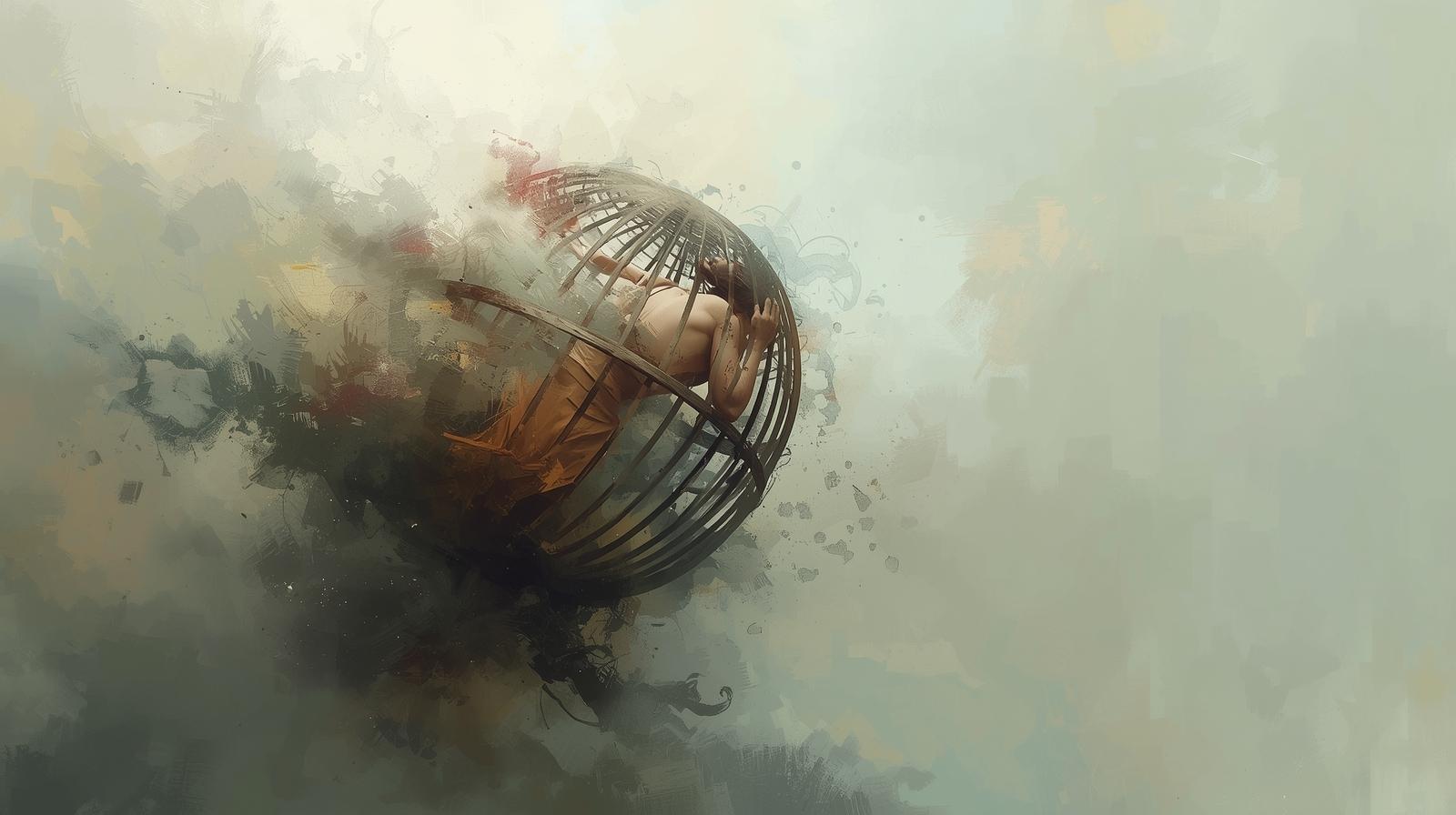
The default natural view is that we’re looking to have our identity saved, of who we take our self to be. And so the goal is to try and fix it or improve it or make it better. But the spiritual view flips this and it says that the goal is not to save our identity but to be saved from it; we’re not trying to polish the cage we’re in, we’re trying to be set free from the cage itself.
Finding Our True Life
So the traditional view is that the Lord comes into the world to save ‘me‘ and everything hinges on what we understand by that ‘me‘. We want that ‘me‘ to go to heaven but in fact the Lord comes into the world to save us from that, because that ‘me‘ is hell. And that is what the spiritual life is about and why the Word is so important, for it points out the very things that we cannot see for ourselves because we are so immersed in what is opposed to what the Lord is seeking to do.
So what does being saved from “our self” look like, how is it achieved?
To grasp this we need to be introduced to a self concept that is, so far as I’m aware, unique to Spiritual Christianity.
The As-Of Self
This self concept is the secret key that unlocks the whole thing. It’s this beautiful idea called the as of self. The idea is that we are given this feeling of being independent for a very, very good reason. It’s a gift. It gives us a sense of agency, of free will, so we can choose to love, to connect, to give back. We get to act as if our life is our own, while always remembering in our hearts that it’s an appearance, but when ordered it is a beautiful appearance created for the sake of love and relationship.
The… contents of the proprium which have been given life by the Lord look beautiful and attractive, varying according to the life to which a celestial quality that is the Lord’s can be added. (Arcana Coelestia 154)
So it is not in having a sense of self that is the problem, it’s what we do with it and how we interpret it that becomes the issue. The sense of self is absolutely critical to give us a sense of otherness. It also means that it gives us a sense of freedom by which we can use our rationality to move toward loving the Lord and the neighbour.
One of the interesting things about this is that if you look at Eastern religions, they don’t have the concept of an as of self. They instead carry the idea that we all are just part of the Divine being and that the ultimate goal is becoming merged with it. In the West, where this idea is not available, we become little God’s unto ourselves and we relish the idea that we are individual, autonomous beings separate from all else, ruling over the domain of our own sphere of influence. So this beautiful truth that the Lord has brought through the doctrines for Spiritual Christianity in this concept of an as of self, balances all of that out. It offers us a middle path in the way that maintains an experience of agency but also establishes a sense of connection to the Lord and to others.
The False Self Versus the True Sense of Self
False
I AM the source
Anxiety, control, defence, isolation
True
I AM NOT the source
Freedom, peace, connection
We can think of the belief in our self as the source of our life and the belief in the Word that I am not the source of my life like two doors or two completely different ways to live. On the one side, we have the false sense of self and on the other we have the true sense of self. The false sense of self claims I AM the Source and so is in the constant need to find ways of confirming the falsehood as something true. It’s driven to using others to gain affirmation, manipulating situations and trying to control outcomes; essentially it lives in constant fear and anxiety of being exposed for fallacy that it is. It can’t but produce what is evil and false because its not aligned with reality. The fruit of this is defensiveness and isolation. This is the hell the Lord seeks to save us from. Contrast this with that sense of self, the as of self, that aligns itself with reality. When the false self concept is let go of and it is seen that the Lord is the only life, that “I am not the source” then ones experience of life is transformed into a heavenly life of freedom, peace and connection.
All these truths might sound very simple but they make huge difference in terms of our quality of life when remembered.
So I’m just going to leave you with this final thought to chew on, to digest. And its a question we can particularly ask in any given moment of internal unrest. After all the work, all the striving, all of the self-improvement…
What if that very self that we seek to have saved, is what the Lord is seeking to save us from?